


Taping Foals for Limb Deformities: Why Timing Matters
Angular and flexural limb deformities are relatively common in newborn foals, and taping can play a meaningful role in supporting correction – but only if it starts early enough. Because a foal’s growth plates close within the first months of life, the window for taping to meaningfully influence limb alignment is much shorter than in an adult horse.

A short window for the biggest effect
Bone growth in a young foal happens at the growth plates, and different growth plates close at different ages – some as early as three months, others closer to five or six. Once a growth plate has closed, the bone can no longer be gently influenced to grow straighter, and correction generally requires a surgical approach instead.
This is why the general advice for angular and flexural deformities is the same: have the foal assessed as early as possible after birth, and start a treatment plan – taping included – well before growth plate closure, rather than waiting to see whether the leg “grows out of it” on its own.

Matching the tape to the goal
Kinesiology tape can stretch considerably beyond its resting length, and how much stretch is used changes what the application actually does. A firmer, less elastic application behaves more like a light splint, limiting unwanted movement while a joint needs relative rest. A more elastic application, applied with less tension, instead encourages movement and helps stimulate the foal’s own muscles to work correctly.
As with any taping application, the direction matters as much as the stretch: taping from origin to insertion is used to facilitate a muscle’s own contraction, while the opposite direction is used to encourage relaxation. Getting this right depends on a solid understanding of the anatomy involved – which is also why taping foals is a task for a trained animal physiotherapist, veterinarian, or someone working directly under their guidance, not a general DIY exercise.
Working in phases, not a single application
A single taping session rarely tells the whole story. In practice, a foal’s treatment plan typically moves through phases as the leg responds:
- Early phase: a more supportive, stabilising application, particularly useful if the foal is struggling to stand or move confidently.
- Middle phase: as the limb becomes more stable, the application is gradually made less restrictive and more elastic, shifting the emphasis towards guiding movement rather than limiting it.
- Later phase: tape is used mainly to fine-tune the standing posture and reinforce the improved alignment, tapering off as the leg approaches a normal stance.
Tape is typically reapplied every few days to a week, both because the adhesive naturally wears and because the plan itself is adjusted at each visit based on how the leg is responding.

A team effort between vet and therapist
Because a foal’s presentation can range from a mild, self-correcting stance to a deformity that ultimately needs surgery, taping is best used as part of a plan set jointly by a veterinarian and an animal physiotherapist – not as a stand-alone fix decided on the yard. The vet rules out other causes and confirms whether conservative management is appropriate, while the therapist manages the day-to-day taping and monitors progress.
Handling also matters: foals are small, easily startled, and not used to being restrained, so taping is usually done calmly on the ground with an assistant supporting the foal, rather than while it is standing unrestrained.
In the media: a Dutch equine therapist’s experience
Dutch equine masseur and movement therapist Rosanne Tijssen-van Zelst (Equi-Massage) has taped foals with limb deformities for several years and shared her approach in an interview for the Dutch equestrian magazine De Hoefslag. It’s a good real-world read if you’d like a practitioner’s perspective alongside the general guidance above.
Read: “Medical taping bij veulens – zo vroeg mogelijk ingrijpen”, De Hoefslag, issue 5 (2022)
Article by Yvonne Buis-Franken, photos by Rosanne Tijssen-van Zelst. Dutch language.
Recommended taping products
-

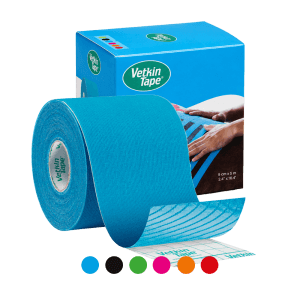
VetkinTape® 6cm
€13.95In stockSelect options This product has multiple variants. The options may be chosen on the product page -
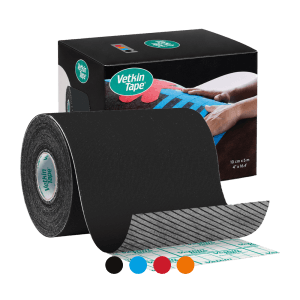
VetkinTape® 10cm
€19.95In stockSelect options This product has multiple variants. The options may be chosen on the product page -
VetkinTape® Soft Touch Scissors
€12.95In stockAdd to cart -
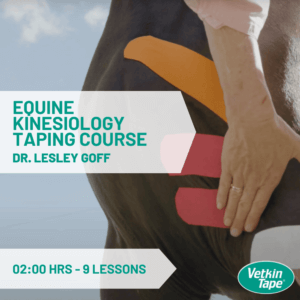
Online Equine Kinesiology Taping Course – 2 hrs
€59.99Direct availableAdd to cart

VetkinTape veterinary kinesiology tape
VetkinTape is an elastic & adhesive kinesiology tape developed specifically for veterinary purposes. It is used by animal physiotherapists and veterinary professionals to relieve pain, improve muscle function, blood circulation & lymphatic flow, and support joints.
Attention: We would like to remind you that certain tape applications provided on our website are not yet fully scientifically proven. Mentioned applications are based on extensive evaluation and case studies with licensed veterinary physiotherapists and/or other veterinary professionals. Always have a foal’s limb deformity assessed by a veterinarian before starting any taping programme.