


Sacroiliac (SI Joint) Pain in Horses
Sacroiliac pain in horses can be caused by a Sacroiliac Joint Dysfunction in the sacroiliac region. Unfortunately, SI joint injuries are fairly common among horses. A VetkinTape application allows veterinary professionals to aid the horse with the recovery and rehabilitation of an SI-joint dysfunction.

Sacroiliac or SI-joint in horses
The sacroiliac joint (SI-joint) connects the sacrum to the hip bones (iliac crests) and its main function is to absorb the shock between the back and the hind end of the horse. It is the important connection that allows movement to travel from the hind leg over the spine to the front of the horse. The SI-joint itself has only little movement, because of strong ligamental and muscular connections. Due to stress the joint can become inflamed, even immobilised or unstable, and therefore cannot function properly any more.

What causes SI Dysfunction injuries
Repeated stress on the SI-joint of the horse, for example caused by overstrain as a consequence of too much or the wrong training, leads to irritated and inflamed tissues, so the horse feels discomfort and pain. Often the development of a Sacroiliac Joint Dysfunction occurs gradually, but acute cases can also happen suddenly after an injury or trauma, such as a fall in the pasture or an unfortunate landing after a jump. A chronic SI injury persists for at least three months and will require a much longer period of time and more repeated VetkinTape applications to recover.
Symptoms of equine SI-Joint Dysfunction injury
- The horse’s movement will be restricted and it can also show behavioural signs of discomfort.
- Often the strides of the hind legs are shorter, because they don’t swing forward as much due to the restriction in the horse’s joints.
- Trouble with cantering or backing up can also be connected to a Sacroiliac Joint Dysfunction.

Prevention of SI-Joint injuries in horses
The SI taping application can also help with the prevention of an SI-joint dysfunction. The professional equine therapist can help the horse by taking stress off the structures and improving the motion of the joint, so injuries are less likely to occur.
- After competitions or intense training and riding sessions, the horse needs enough recovery time, especially for strongly stressed joints like the SI-joint and the surrounding muscles.
- Keeping an eye on the horse, its condition and performance allows problems to be detected early and prevents further damage, for example from a chronic SI dysfunction.
- Smart training management with extended warm-up periods and a controlled cool-down phase after work or hard competitions protects the horse’s body from these injuries.
Taping horses for sacroiliac pain
Safety precautions – The professional should be in a safe place when working on a horse and make sure to check the surroundings. The horse should be held and not tied up, in case it gets scared or irritated by the tape. The handler should stand on the same side of the horse as the working professional. The ground may not be slippery.
The application of VetkinTape on the SI joint can be supported with other tape applications or therapeutic techniques. The VetkinTape can stay on for a few days, and after that the application can be renewed if necessary. Usually a controlled treatment and exercise plan over a duration of 2–4 weeks is suggested.

Step-by-step equine kinesiology taping application
- For the SI joint taping of the horse, four I-tapes are needed, each about 25 cm long depending on the size of the horse.
- The edges should be rounded to prevent the tape from detaching. The tape will be attached in a star formation, on top of each other, over the same spot.
- The first strip is applied under maximum stretch along the spine (pull dorsal and caudal). The ends of each strip need to be applied with no stretch, then rub over the tape to activate the adhesive coating.
- The second strip is applied with maximum stretch, at a 90-degree angle on top of the first tape.
- The third and fourth strips are each applied at a 45-degree angle to the first tape.
- The finished tape application should have the appearance of a star (or a flower).

VetkinTape: more efficient sacroiliac rehabilitation
A VetkinTape application allows veterinary professionals to aid the horse in recovering from an SI-joint dysfunction. A complete examination of the horse should always precede treatment, along with consideration of any other causes for the symptoms the horse is showing. A ligament technique across the region of the SI-joint is used to reduce pain and to detone the high tension in the tissues. The goal is to restore the normal range of motion and allow the horse to move more comfortably and freely. The movement patterns of the horse can also be positively influenced by VetkinTape addressing its sensory perception. In addition to taping the SI joint, an individually controlled exercise programme is recommended.
Photo: left, before treatment. Right, after treatment.
Recommended taping products
-

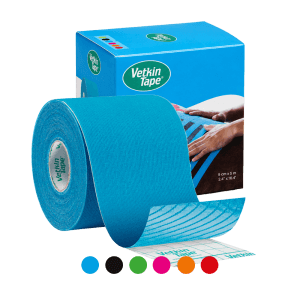
VetkinTape® 6cm
€13.95In stockSelect options This product has multiple variants. The options may be chosen on the product page -
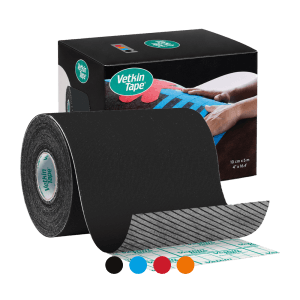
VetkinTape® 10cm
€19.95In stockSelect options This product has multiple variants. The options may be chosen on the product page -
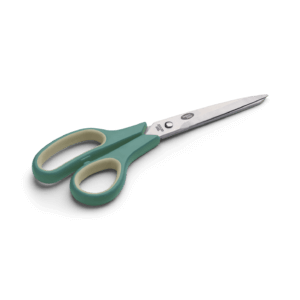
VetkinTape® Soft Touch Scissors
€12.95In stockAdd to cart -
Online Equine Kinesiology Taping Course – 2 hrs
€59.99Direct availableAdd to cart


VetkinTape veterinary kinesiology tape
VetkinTape is an elastic & adhesive kinesiology tape developed specifically for veterinary purposes. It is used by animal physiotherapists and veterinary professionals to relieve pain, improve muscle function, blood circulation & lymphatic flow, and support joints.
Summarised by Laura Wildschut, Equine Physical Therapist and Trainer.
Attention: We would like to remind you that certain tape applications provided on our website are not yet fully scientifically proven. Mentioned applications are based on extensive evaluation and case studies with licensed veterinary physiotherapists and/or other veterinary professionals.