


Angular Limb Deformities in Foals
Angular limb deformities (or ALD) in foals describe a condition of crooked legs in newborn foals. Kinesiology taping is a particularly interesting technique for use on angular limb deformities in foals.

What is angular limb deformity (ALD)
Angular limb deformities (or ALD) in foals describe a condition of crooked legs in newborn foals. The limb deviation can be seen in either one front, one hind, or even more limbs.
A veterinarian should always be consulted on cases of newborn foal leg problems. With exercise of the foal, the stance of the limbs can correct itself in the first couple of days after birth, but if not, treatment should be performed in a timely manner to prevent subsequent problems.
What causes leg deformities in foals
Newborn foals are regularly born with an angular limb deformity. Reasons for this can be, for example, a poor position in the womb of the mare, a premature birth, or other complications during the birth process of the foal. Further reasons can be developmental problems connected to the growth plate, or accidents such as a kick from another horse leading to trauma.

Symptoms of foal leg problems
A deformity of the forelimbs and hind limbs is generally visible from the front and back, as well as measurable. Usually it should be possible to draw a straight line between all the joints, from the top of the leg down to the hoof. With angular limb deformities, an angle can be noticed and even measured instead of a straight line.
The foal might also show:
- Lameness
- Laxity of the ligaments
- Swollen and inflamed joints
- Uneven wearing of the hoof wall, or
- Incomplete formation of the bones in the affected limb

Carpus valgus: the most seen deformity in horses and foals
There are two types of deformity: the so-called valgus deformity (lateral deviation of the limb) and varus deformity (medial deviation of the limb). Carpus valgus in one or both front limbs is the most commonly seen deviation in foals. It describes the lateral deviation of the knee.
Prevention of foal leg deformities
To help prevent angular limb deformities in foals, the breeding management of the mare should be well planned. A balanced diet for the mare during pregnancy and avoiding unnecessary stress are important factors.
After the foal is born, the risk of outside trauma should be considered, and exercise time and surroundings should be kept under controlled circumstances, at least during the first days.
Veterinary taping foals for angular limb deformities
Kinesiology taping is a technique using elastic orthopaedic tapes. One of the effects of the tape is promoting stabilisation of anatomical structures, which is why it is particularly interesting for use with angular limb deformities in foals.
Step-by-step application of kinesiology taping with foals
- In both cases, a 20 cm VetkinTape was applied with 30% stretch over the medial aspect of the affected limb to support the medial collateral ligament of the carpus.
- A 10 cm VetkinTape was used for the two anchors, wrapped over both ends of the first tape to anchor that first strip.
- The tape was changed every five days and the foals were reassessed at 15 days of treatment. Drs. Solange Mikail used ImageJ software to measure the angles of the limbs in the photographs.
Click on the images below to enlarge.
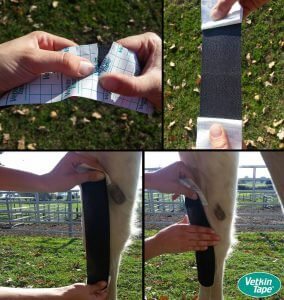
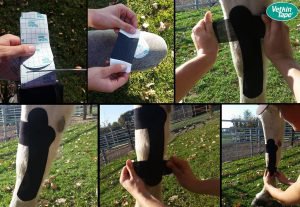

Correction of the limbs with VetkinTape
A foal grows rapidly during the first couple of months, which is why correcting the limbs with VetkinTape in a timely manner can have a positive effect. The result of the equine kinesiology taping treatment depends on the severity of the limb deformity to begin with. If treatment is started before physeal closure, the prognosis is generally good. There are conservative and surgical treatment options, depending on the severity and details of the case.
In the examination by Solange Mikail, two foals (one 30 and one 60 days old), each with carpus valgus in one front limb, were successfully treated with applications of VetkinTape.

Published research on kinesiology taping and angular limb deformities in foals
Drs. Solange Mikail is a veterinarian, animal physiotherapist, member of the ACVSMR, and instructor of VetkinTape courses. Her research on correcting angular limb deformities in foals with VetkinTape was first presented as a poster at the 10th International Congress of Veterinary Rehabilitation and Physical Therapy (IAVRPT) in Knoxville, USA (30 July–3 August 2018), where it was honoured as the best presentation.
The study was subsequently published as a peer-reviewed conference abstract:
Mikail S, Villaça Issa de Araujo M, Jatobá MV, Gonçalves e Silva MI, Menezes de Carvalho L.
Correction of angular limb deformities in foals using kinesiology taping.
Proceedings of the 10th International Symposium on Veterinary Rehabilitation and Physical Therapy.
Acta Veterinaria Scandinavica. 2019;61(Suppl 1):A22.
https://doi.org/10.1186/s13028-019-0439-3
In this study, two foals with carpus valgus (a 30-day-old filly and a 60-day-old colt, each affected in one front limb) were treated with a 20 cm VetkinTape® application at 30% stretch over the medial aspect of the affected limb, reapplied every five days. Over 15 days of treatment, the carpal angle in both foals moved measurably closer to a normal alignment.

Carpal valgus deformity in dogs
Angular limb deformity (or valgus deformity) is also seen quite often in dogs. Here too, mainly young animals under the age of one year are affected. The deformity can occur due to trauma or as a result of abnormal bone growth. After a physical examination and X-rays, the veterinarian can suggest a treatment plan; surgical methods are often still used to correct the affected limb. Depending on the case and severity, applications with VetkinTape can be used to support treatment. The VetkinTape application for a valgus deformity in a dog, for example in the carpus, corresponds to the equine application described above.
Recommended taping products
-

VetkinTape® 6cm
€13.95In stockSelect options This product has multiple variants. The options may be chosen on the product page -
VetkinTape® 10cm
€19.95In stockSelect options This product has multiple variants. The options may be chosen on the product page -
VetkinTape® Soft Touch Scissors
€12.95In stockAdd to cart -
Online Equine Kinesiology Taping Course – 2 hrs
€59.99Direct availableAdd to cart
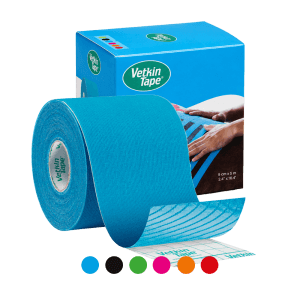
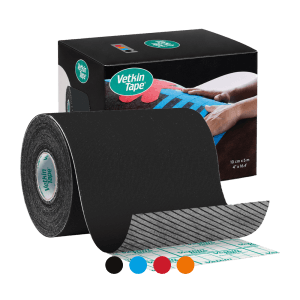

VetkinTape veterinary kinesiology tape
VetkinTape is an elastic & adhesive kinesiology tape developed specifically for veterinary purposes. It is used by animal physiotherapists and veterinary professionals to relieve pain, improve muscle function, blood circulation & lymphatic flow, and support joints.
Summarised by Laura Wildschut, Equine Physical Therapist and Trainer.
Attention: We would like to remind you that certain tape applications provided on our website are not yet fully scientifically proven. Mentioned applications are based on extensive evaluation and case studies with licensed veterinary physiotherapists and/or other veterinary professionals.